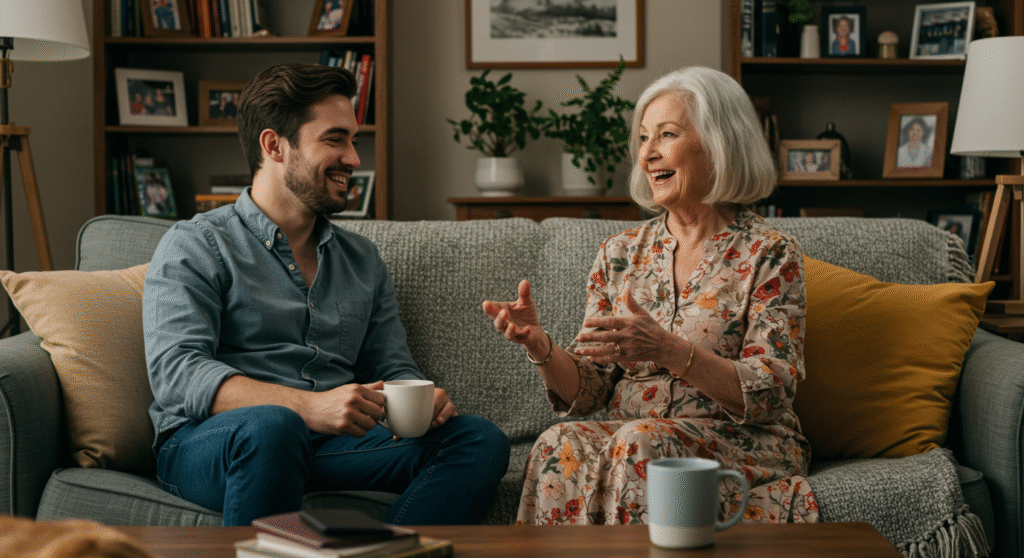
Why Moving in With Your Children Might Cost You More Than You Think: The Unspoken Truth
As we get older, it’s natural to reevaluate where—and how—we want to live.
For some, moving in with adult children feels like a smart, even comforting option. It offers safety, support, and the promise of togetherness. But too often, that move brings quiet trade-offs that no one fully sees coming. Especially for women and men over 50, this shift can gradually chip away at essential freedoms—starting with privacy, and ending with a loss of identity.
“You are never too old to set another goal or to dream a new dream.”
– C.S. Lewis
Let’s look at the five key rights that often disappear in the process—and how to hold onto them.
Privacy and Personal Space
The First Thing to Go
Living alone (or with a spouse), you get used to a certain rhythm. You eat when you want. You nap when you need. You walk around your house without explanation. That’s not just convenience—it’s freedom.
But move into your child’s home—even with love and best intentions—and suddenly you’re knocking on doors, adjusting to their routines, and asking before turning on a light.
This isn’t always hostile. Often, it’s unspoken. And that’s what makes it hard.
Loss of privacy can lead to stress, anxiety, and even depression. A study from the National Institute on Aging found a noticeable mental health decline among older adults who lost personal space after moving in with family.
What helps:
Set boundaries before the move. Think about private entrances, agreed-upon quiet hours, and a clear understanding that your space—however small—is truly yours.
Financial Control
When Help Turns Into Oversight
It usually starts with good intentions:
“We’ll help with the bills.”
“I’ll just log into your account for you.”
“Let’s keep all the payments in one place.”
Soon, purchases are questioned. Gift orders get canceled. And before long, you’re asking to use your own money.
Older adults—especially those who’ve managed households for decades—deserve to maintain financial control. It’s not about spending freely. It’s about choice.
What helps:
Keep separate accounts. Stay involved in your financial decisions. If help is needed, make sure it’s collaborative, not restrictive.
Decision-Making Power
The Subtle Loss of Daily Choices
In your own home, you choose what’s for dinner. What you watch on TV. When you wake up.
In someone else’s home? These decisions are often pre-made by the household’s rhythm. You adapt—not because you want to, but because it’s easier than being labeled “difficult.”
Over time, this can lead to something called learned helplessness—a mindset where you start to believe your choices no longer matter. That mindset accelerates physical and mental decline.
What helps:
Talk about lifestyle preferences before moving in. Keep choosing for yourself whenever possible—whether it’s your wardrobe, your meals, or how you spend your afternoon. Your voice still matters.
Legal and Medical Authority
When Others Start Speaking for You
Here’s what often happens:
A child joins you at a doctor’s visit, and suddenly the doctor addresses them—not you.
The pharmacy calls them with updates.
Paperwork gets routed through their email.
It seems helpful. But without clear boundaries, this shift can affect your legal standing—especially in states where courts favor the adult child in guardianship issues if you’re living under their roof.
What helps:
Before the move, set up clear documentation:
A Durable Power of Attorney
A Healthcare Directive
A Living Will
These don’t mean giving up control—they ensure your wishes are protected, clearly and legally.
Social Freedom
The Quiet Disappearance of Connection
You don’t just leave a house when you move—you leave neighbors, routines, clubs, and community.
Suddenly, seeing friends means coordinating someone else’s schedule. Hosting visitors feels awkward in someone else’s space. Routines you built for decades dissolve into silence.
According to Harvard’s long-term aging study, strong social ties are more important to longevity than diet or even exercise. When you lose connection, you lose a vital source of health.
What helps:
Plan ahead for transportation, communication, and social outings. If you’ve already moved, find ways to reconnect—through senior centers, online meetups, or simply calling old friends.
You Still Have a Say
The decision to move in with family shouldn’t be rushed—and it shouldn’t come at the cost of who you are.
Ask yourself:
What freedoms matter most to me?
What parts of my daily life do I want to keep?
Where am I willing to compromise—and where am I not?
Then, have the hard conversations. Put things in writing. Talk about boundaries, expectations, and how love can support independence—not replace it.
Because aging isn’t about disappearing into someone else’s life.
It’s about continuing to live your own—with strength, choice, and dignity.
– Julie W.
Real life, real experiences. Share your wisdom, your wins, or even the mess — because life after 50 is worth talking about.